
Where to Put Security Cameras Around a House
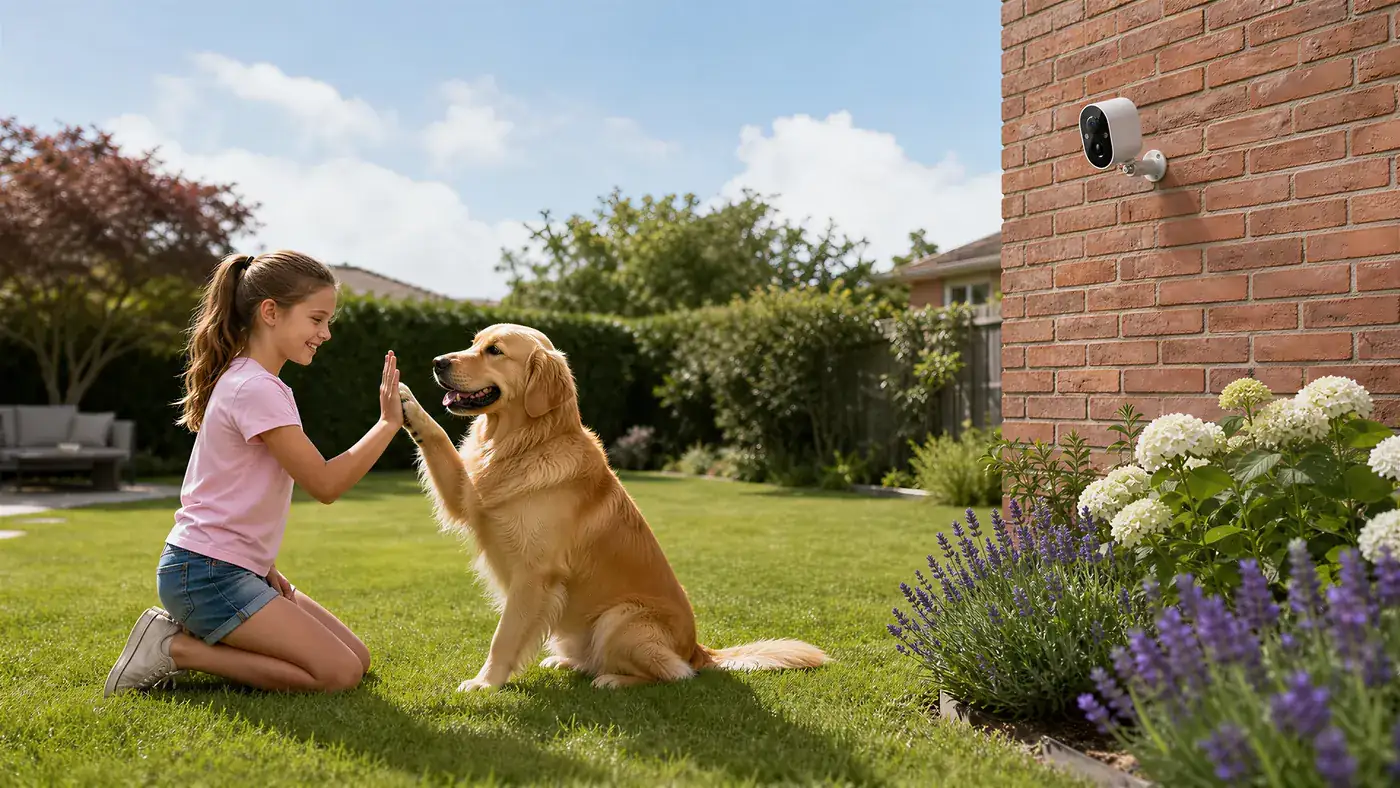
Cover entry points first, in the order someone would actually reach them — the front door, then the back or side door, then whichever window, gate or flat roof offers the easiest way in. A camera aimed at a doorway a person has to stand in front of is worth more than a camera sweeping a wide garden where everybody is a distant shape. Work out the positions by walking the approach a stranger would take, and the number of cameras you need falls out of that walk instead of being decided in a shop.
Most people do this in the opposite order. They buy three cameras, then look around for places to put them, and end up with three wide, attractive views that prove something happened without showing who did it. Correcting that costs nothing at all: decide the positions first, and buy the number those positions demand.
This article is about choosing positions. How high each camera goes, and at what downward angle, is a separate question covered in how high to mount an outdoor camera.
Why entry points beat wide views
A camera spreads a fixed amount of detail across whatever it is looking at. Widen the view and that detail is stretched over more ground, so a face at the edge of the frame becomes a pale smudge. Narrow the same camera onto a doorway and you get a face you could actually describe to somebody.
There is a second reason, and it matters more than the first. Identification needs a moment of stillness. A person crossing a lawn is moving, often quickly, usually at an angle, frequently in the dark. A person at a door stops — to knock, to try the handle, to look over their shoulder. That pause is where usable footage comes from, and it only happens at entry points.
The same logic applies at night, when most of the footage people actually need gets recorded. Infrared light falls off sharply with distance, so a subject close to the camera is lit and a subject across the garden is a grey outline. If your night images are disappointing everywhere, the cause is often distance and glare rather than the camera — why cameras look blurry at night goes through the usual culprits.
Walk the approach before you mount anything
Do this once, properly, and the plan writes itself.
The stranger's walk
Go out to the pavement or the road and walk towards your house the way somebody would if they had no key and did not want to be noticed. Do it slowly. Stop where they would stop.
Pay attention to four things:
- Where does the path narrow? Gates, gaps between the house and a fence, the space between parked cars. Anyone coming in has to pass through these, which makes them excellent camera positions.
- Where is there cover? Tall hedges, a recessed porch, the shadow behind a garage. Cover is where someone waits, and where a camera aimed elsewhere will miss them entirely.
- Where would you try first? Be honest. Usually the least visible door, the window nobody can see from the street, or the side gate that is never locked.
- What is behind you at each stop? A camera facing a bright sky, a street lamp or a low sun will lose everything in front of it to glare.
Do it again after dark
The daytime walk and the night walk give different answers. A route that looks exposed in the afternoon can be completely black in the evening, and the security light you were relying on may cover only a fraction of it. Walk the same path at night, with the outside lights in their normal state, and note where you disappear.
The positions that matter on most houses
The front door
The single most valuable position in almost every home, because deliveries, visitors, callers and most opportunists all end up there. Aim it so somebody standing at the door fills a good part of the frame, and so the camera also catches the last few steps of the approach — that gives you the walk-up, not just the moment they are already at the handle.
Avoid mounting it directly above the door pointing straight down. It feels tidy and it produces footage of the top of a head, a hood or a cap. Offset it slightly to one side so the face is seen from an angle rather than from above.
The back door and side doors
The back is where the front's deterrent effect sends people. A back door is usually out of sight of the street, often has weaker locks and glass beside it, and is where a camera earns its keep even though nobody ever sees the footage from it.
Side doors, utility doors and the door from an attached garage all count as entry points. If it opens and it is not visible from the road, it needs a camera or must sit inside another camera's field of view.
The driveway, gate or parking space
A driveway camera does several jobs at once: it shows vehicles arriving and leaving, it covers the approach to the front door, and it catches anything happening to the cars themselves. Position it so it sees the length of the drive rather than looking across it, so somebody walking up is in frame for several seconds rather than one.
If your gate is the only way in, that gate is a better position than the middle of the garden. Pinch points always are.
The dark side of the house
Nearly every home has one elevation nobody looks at: a narrow passage down the side, the space behind a garage, the corner where the bins live. It is dark, hidden from the street, and usually where a ladder or a garden tool is stored. It rarely justifies a camera of its own on a small property, but it must be visible from one of your others.
One camera inside, at the landing point
If you are willing to have a camera indoors, the useful position is not a bedroom or a living room but wherever everything funnels through — the hallway, the stairs, the landing. Someone who got in has to pass it, and unlike the outdoor cameras it will not be defeated by rain, glare or a hood.
Blind spots people create without meaning to
- Mounting too high. The higher the camera, the more you see the tops of heads and the less you see faces. Height buys coverage and loses identification, which is the wrong trade at an entry point.
- Pointing into the light. A camera aimed at a sunrise, a sunset, a street lamp or a security light will expose for the bright part and leave the person in front as a silhouette.
- Sitting right beside a porch light. The light draws insects, insects walk across the lens at night, and the camera treats each one as motion. The result is a phone full of alerts and nothing to look at.
- Shooting through a window. An indoor camera pointed out through glass sees its own infrared reflected back at night. Almost every "my camera works in the day but not at night" complaint from an indoor camera comes down to this.
- Leaving a gap between cameras. Two cameras that each cover their own area but nothing in between give an intruder a corridor. When you set them up, check that each camera can see the ground beneath the next one along.
- Ignoring what happens in six months. The branch that is small today will fill the frame by summer. Positions need a second look after a season.
So how many cameras does a house need?
Count entry points, not rooms and not corners.
A small terraced house with one front door and one back door genuinely needs two, and the second one matters more than most owners expect. A detached house with a driveway, a side gate and patio doors will need more, because each of those is a separate way in that the others cannot see.
The useful rule is: every entry point is either covered by a camera of its own, or clearly inside the frame of a camera covering something else. When that is true, adding more cameras improves the record but no longer closes a hole. When it is not true, no amount of resolution compensates.
Two positions are worth having even though they are not entry points: the approach — the drive, the path, the gate — because it gives you warning and a clean view of someone walking in, and the interior landing point if you accept an indoor camera at all.
Fit the practical constraints in before you drill
A position is only real if you can power it, connect it and review it.
Power. Every position needs either a cable route or a battery-and-solar arrangement. If the best spot has no socket near it, a solar camera keeps it in play — though the panel has its own placement rules, covered in where to mount a solar panel for a camera.
Connection. Wi-Fi at the far corner of a garden, behind a brick wall, is often much weaker than the same distance indoors. Test the signal at the exact spot before committing, and if it is not there, decide between an extender and a mobile-connected camera — Wi-Fi versus 4G cameras sets out that choice.
Recording and review. Footage you cannot retrieve is not evidence. Confirm each camera is actually writing to its card — when a camera stops recording to the SD card covers the usual reasons it silently gives up — and get comfortable finding a clip by time before you need one in a hurry.
One more constraint that is not technical: what your cameras can see of other people. Rules on filming a public street, a shared entrance or a neighbour's garden and windows vary from country to country and sometimes from city to city. Aim at your own property, keep neighbouring windows out of frame where you can, and check the rules that apply where you live rather than assuming.
Frequently asked questions
If I can only have one camera, where should it go?
The front door, in almost every case. It covers deliveries, visitors and callers as well as anyone who should not be there, and it is the one position where a person reliably stops and faces the camera. If your front door is overlooked by a busy street and your back door is completely hidden, reverse that — the hidden door is the one that needs watching.
Should cameras be visible or hidden?
Visible, for outdoor cameras. A camera somebody notices before they commit to anything is doing preventive work that no recording can do afterwards. Visible does not mean reachable, though: place it where it can be seen from the approach but not knocked off or covered from the ground. Concealment mainly makes sense indoors, and only where local rules allow it.
Do I really need a camera at the back of the house?
If the back has a door, a patio door or ground-floor windows that cannot be seen from the street, yes. A well-covered front tends to push people to the side and the rear, so an unwatched back door is exactly the gap your front camera creates. If your back is genuinely enclosed with no access at all, spend that camera on the driveway instead.
One camera with a wide view, or two with narrower ones?
Two narrower ones, if the choice is between covering an area and identifying a person. A wide view tells you that something happened and roughly where; a narrower view at an entry point tells you who. Wide angles are useful for the approach and for general awareness, but they should not be the only thing watching a door.
Where should I definitely not put a camera?
Anywhere aimed straight into a light source, anywhere behind glass, and anywhere a person can reach without effort. Indoors, keep them out of bathrooms and bedrooms, and be careful with any position that captures a neighbour's windows or a shared hallway — that is where placement stops being a technical decision and becomes a legal one.
How do I check my placement is any good before I fix it permanently?
Hold the camera in position, view the live image on your phone, and have somebody walk the approach while you watch. Do it in daylight and again after dark. You will spot glare, gaps and a too-high angle in about a minute — far quicker than discovering them from a recording you needed and could not use.
Planning camera layouts for customers
If you install cameras for other people, the site walk is the part worth charging for. Counting entry points, checking the night-time light and testing the connection at each proposed spot removes nearly every callback about a camera that "doesn't show anything". If you sell or install security cameras and want to discuss supply and dealer terms, see the Yoosee partner information.