
Camera With Siren: How to Set Up the Motion Alarm So It Actually Helps
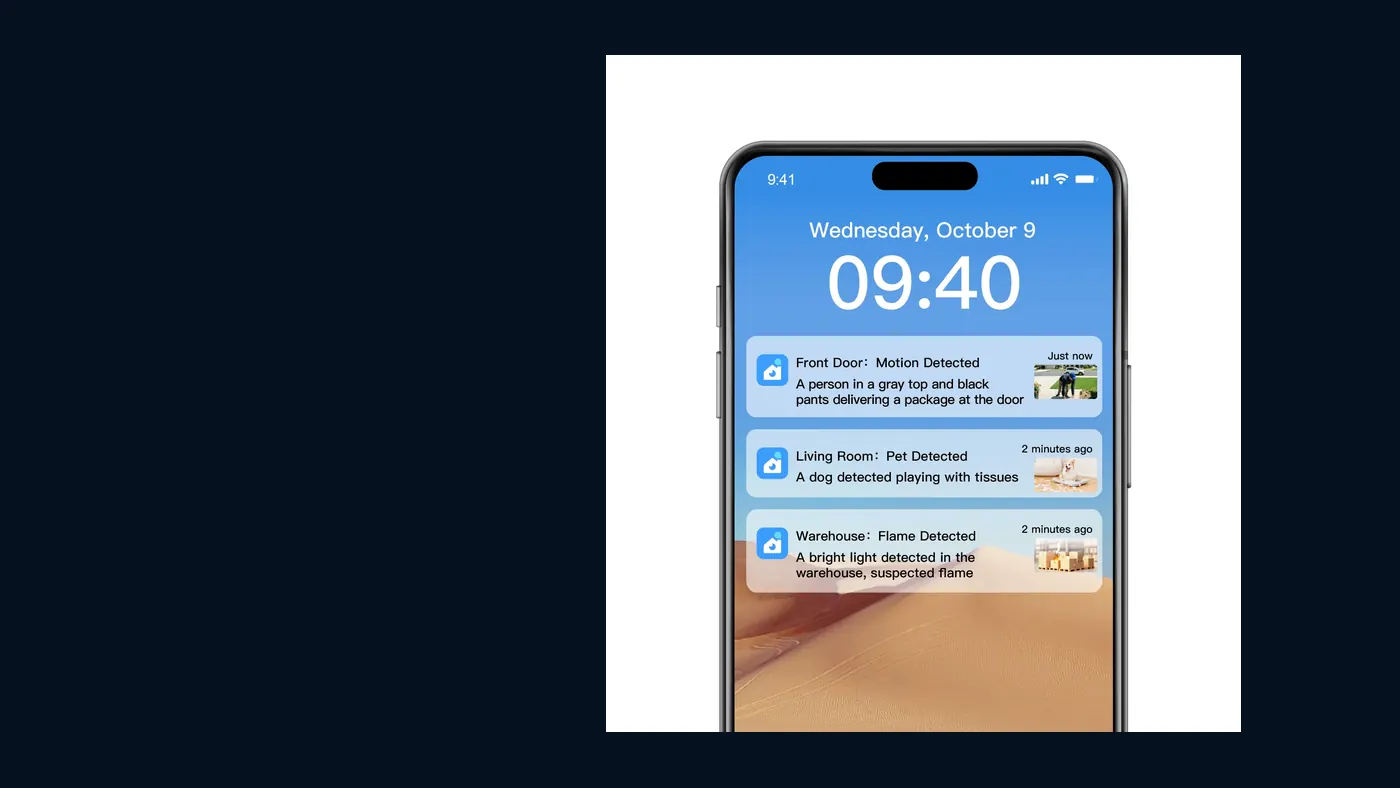
A camera with siren only deters anyone if three things are set correctly: the siren is linked to motion detection, it is scheduled for the hours when nobody should be there, and the detection area is narrow enough that cars, cats and neighbours do not set it off. Get them wrong and it becomes noise the street learns to ignore, or the reason you switch it off for good.
This guide walks through the order that works: confirm what your camera has, link the alarm to detection, build a schedule, tune it so it does not bother anyone, and then test it, including triggering it by hand from your phone.
Step 1: Check what your camera actually has
Not every camera that works with the app has a siren, and those that do differ in what they offer. Before looking for settings, check the box, the label on the camera, or the manual for your model. You are looking for some combination of:
- A built-in siren or alarm sound — a loud tone played through the camera's speaker.
- A warning light — on some models a flashing coloured light, on others a white spotlight that switches on when motion is detected. Check which type your model has.
- A custom voice message — some models let you record a short spoken warning that plays instead of, or before, the siren.
- Manual trigger — a button in live view that sounds the siren on demand.
If none of these appear in the camera's settings, the hardware is probably not there; the app cannot add a speaker or light the camera does not have. If your camera has two-way audio but no dedicated siren, you can still speak through it from live view, which is often just as effective when you are watching.
Step 2: Turn on motion detection first
The siren follows motion detection. If detection is off or badly tuned, the siren will either never sound or sound constantly, so set detection up before you touch the alarm.
- Open the camera in the app and go into its settings. Look for a section named motion detection, alarm settings, or smart alerts — menu names differ slightly by app version.
- Switch motion detection on and set the sensitivity to a middle level to start with. You will adjust it after testing.
- If your model offers human detection (sometimes called person detection or humanoid detection), turn it on. A siren that fires only for people rather than for any movement is far less likely to go off for a moving branch or a passing headlight.
- Check that alerts reach your phone. The siren is meant to scare someone off; the alert is what tells you it happened. If alerts do not arrive, work through why Yoosee notifications are not working before going further.
Step 3: Link the siren and light to detection
Once detection works, connect the alarm to it. On most models this sits in the same alarm or motion settings area, though some app versions put it under a separate "siren", "sound and light alarm" or "deterrence" heading.
- Find the siren or alarm sound option and switch it on. On some models this is a single toggle; on others you choose between a siren tone, a voice warning, or both.
- Set the warning light behaviour if your camera has one. Typical choices are flashing light, steady spotlight, or off. A flashing light alone is a good first level of deterrence that makes no noise at all.
- Choose the duration if the option exists. Shorter is usually better: long enough to make an intruder realise they have been noticed, short enough not to keep the whole street awake. Use the shortest setting that still feels like a warning.
- Set the volume if your model allows it. Start lower than you think you need and raise it after testing at the property boundary.
- Save and leave the settings page properly, so the camera receives the change. If a setting seems not to stick, close and reopen the camera page and check again.
Light only, sound only, or both?
Think of it as escalation. A light switching on tells someone they are on camera without disturbing anyone else. A siren is a much stronger signal but affects neighbours and family too. A sensible pattern is often the light at all detection times and the siren only during the night schedule — if your model lets you set them independently.
Step 4: Schedule it so it does not fire during the day
An always-on siren is the most common reason people give up on the feature. During the day, the postman, delivery riders, children and your own family will set it off constantly.
- Look for an alarm schedule, arming schedule or time period option within the motion or siren settings. Some app versions schedule the whole of motion detection; others let you schedule the siren separately.
- Set the hours when nobody should be there. For a house, that is often overnight. For a shop, it is the hours after closing and before opening. Pick times that match your real routine, not an ideal one.
- Set different days if you can. A shop closed on one day of the week may want that whole day armed.
- Check the camera's time zone and clock. If the camera's clock is wrong, the schedule fires at the wrong hours. Compare the timestamp on the live view with your phone's time; if they differ, look for a time or time zone setting on the camera.
If your model cannot schedule the siren separately, the simplest workaround is to schedule motion detection as a whole and, if your model and memory card support continuous recording, keep that running all day, so you lose daytime alerts but not footage.
Step 5: Tune it so it deters without bothering the neighbours
A siren that sounds for a car driving past at two in the morning is how you end up in a disagreement with the people next door. Narrow what triggers it.
- Draw a detection zone. If your model supports detection areas, cover only your doorway, gate, yard or shop entrance. Exclude the street, the pavement, and any part of a neighbour's property.
- Re-aim the camera if needed. A camera that looks straight out across a road will always see traffic. Angling it down towards your own entry point reduces false triggers more than any setting can. The guide on where to place security cameras around a house covers angles that keep the frame on your own approach.
- Watch out for headlights and moving plants. At night, sweeping headlights and swaying branches cause many false alarms. Human detection and a tighter zone handle most of this.
- Lower sensitivity in steps. Change one setting at a time and test after each change, so you know which one helped.
- Talk to your neighbours. Telling them the camera has a night siren, and what it covers, prevents complaints and means they are more likely to look out of the window when it sounds rather than shut it out. Rules on noise vary by place, so check local rules if you are unsure.
Step 6: Test it properly
Do not assume it works because the toggle is on. Test it the way an intruder would set it off.
- Test during the scheduled hours, or temporarily set the schedule to cover now and change it back afterwards.
- Walk into the detection zone from the direction a stranger would come — from the gate or the street, not from inside the house.
- Note what happens and how long it takes: does the light come on, does the siren sound, does the alert reach your phone, and is there a recording when you check playback?
- Walk past just outside the zone — along the pavement, past the neighbour's door — and confirm nothing triggers.
- Repeat after dark. Night vision and headlights change what the camera sees, so a setup that is quiet in daylight may not be at night.
- Stand at your boundary while it sounds and judge the volume there. That is what an intruder and your neighbours hear.
Triggering the siren manually from your phone
On models that support it, live view shows a siren, alarm or light button, often near the talk and snapshot buttons. Tapping it sounds the alarm immediately, regardless of the schedule.
This is useful when an alert arrives and you see someone you do not recognise on the feed. Sounding the siren yourself while you watch tends to be more effective than an automatic trigger, because you can follow it with a spoken warning through two-way audio if your camera has it. A few practical points:
- Find the button before you need it. In a real moment you do not want to be hunting through menus. Open live view now and identify it.
- Know how to stop it. Some models stop automatically after the set duration; others need a second tap.
- Check who can trigger it. If you have shared the camera with family or staff, a shared user may or may not have access to the siren button depending on the model and app version. Check from their phone if they are expected to use it.
- Expect a short delay. The command travels from your phone through the internet to the camera, so on a slow connection there can be a pause before it sounds.
Common problems and what they mean
The siren never sounds, but alerts arrive. The siren link is probably off, the schedule does not cover the current time, or the camera's clock is wrong. Check all three in that order.
Neither the siren nor alerts fire. Motion detection itself is off, the detection zone does not cover where you walked, or sensitivity is too low. Fix detection first.
The siren sounds at random times. Look at the recordings from those moments. A car, an animal, rain, insects near the lens at night or a moving shadow is usually visible. Narrow the zone, turn on human detection, or re-aim the camera.
The manual siren button is missing. Your model may not support it, your app may need updating, or you are logged in as a shared user without that permission.
The siren is much quieter than expected. Check the volume setting, and make sure nothing is covering the speaker grille. A camera mounted high up and facing away from you will always sound quieter at ground level.
A battery camera runs down quickly. Every siren, light and recording uses power. Frequent false triggers drain a battery camera fast, so tune the zone and schedule tightly on those models.
When to get help
Contact the place you bought the camera, or check the manual, if the siren option is listed for your model but does not appear in the app after updating, or if the siren never sounds when triggered manually — that may point to a hardware fault. If the camera is mounted somewhere you cannot reach safely, or you need to move it or run new power to a better position, switch off the power first and use a qualified electrician or installer for any wiring or ladder work rather than doing it yourself.
For shops, where the siren is one part of a wider setup, the guide on choosing a security camera for a small shop explains how the door and till cameras fit together.
Frequently asked questions
Will the siren go off every time the camera detects motion?
Only if you link it that way and leave it with no schedule. On most models you can choose whether the siren follows detection at all, restrict it to certain hours, and limit it to a detection zone. Setting it to sound only at night and only for people in your doorway or gate area removes most unwanted triggers.
Can I use just the flashing light without the noise?
On many models, yes: the warning light and the siren are separate settings, so you can enable one without the other. A light switching on is often enough to make a casual intruder move on, and it avoids disturbing your household or neighbours. Check your camera's alarm settings to see whether they can be set independently.
Does a siren actually stop intruders?
It cannot physically stop anyone, but it removes the one thing an intruder relies on — not being noticed. A sudden sound and light make it clear they are on camera and that people nearby may now be looking. It works best together with good camera placement, alerts that reach your phone, and recordings you can play back.
Can I record my own warning message instead of the siren?
Some models allow a custom voice message, and some include preset spoken warnings. If your camera has this, it is usually in the same alarm or siren settings area. Keep it short and clear, and if your camera supports two-way audio, you can also speak live through it from the app.
Why does my siren go off when it rains?
Rain, insects attracted to the infrared lights at night, and droplets on the lens can all register as motion. Turning on human detection, if your model has it, and narrowing the detection zone reduce this. Cleaning the lens and fitting a small hood above the camera can also help.