
Yoosee App Notifications Not Working: How to Get Alerts Back
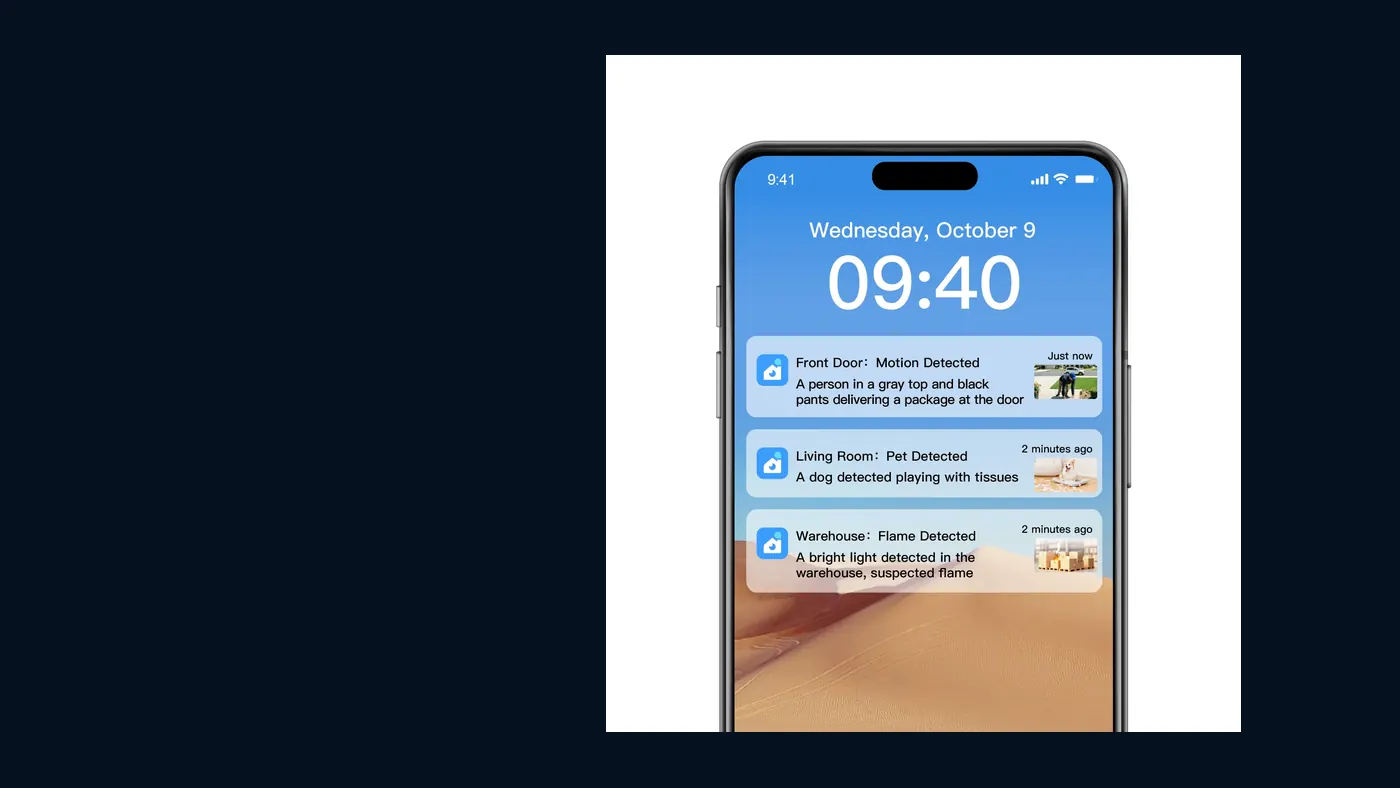
When Yoosee alerts stop arriving, the fault is nearly always in one of three layers: your phone's notification permissions, your phone's battery saving rules killing the app in the background, or a setting inside the app — motion detection switched off, an arming schedule that only covers part of the day, or notifications muted for that one camera.
The order matters. Checking the app first and the phone second is why people spend an hour on this. Work outward from the phone, because a phone that blocks notifications will hide a perfectly configured camera, and nothing you change in the app will make any difference.
This article is about alerts that do not arrive. If the camera itself has dropped off the network, no alert will ever be generated in the first place — that is a separate problem with separate causes.
Step 0: define what "not working" actually means
Three different failures get described with the same sentence, and they have different fixes. Decide which one you have before changing anything.
- No notification at all. Nothing appears on the lock screen, and nothing is waiting in the notification shade. This is almost always permissions or background restrictions.
- Notifications arrive, but silently. The banner is there when you unlock the phone, but it never made a sound or vibrated. That is a sound and Focus-mode issue, not a delivery issue.
- Notifications arrive, but late. Something walks past at 9:04 and the alert lands at 9:31, or the moment you unlock the phone. That is the classic signature of aggressive battery optimisation.
Open the app and check whether the event or alert list inside the app contains the motion event. If the event is recorded there but you never got a push, the camera and detection are working fine and the problem is entirely on the phone. That single check saves most of the guesswork.
Layer 1 — Phone notification permissions
Modern phones ask for notification permission once, at install, and quietly remember a "no" forever.
On iPhone
Go to Settings → Notifications, find the app in the list, and confirm:
- Allow Notifications is on.
- Lock Screen, Notification Centre and Banners are all ticked. With all three off, notifications technically arrive but you never see them.
- Sounds is on, and the banner style is Persistent rather than temporary if you tend to miss things.
- Focus modes are not filtering the app out. Check Settings → Focus for every mode you use — Sleep and Do Not Disturb in particular — and add the app to the allowed list.
- Notification Summary does not include the app. Scheduled Summary batches notifications and delivers them at fixed times, which turns a security alert into a daily digest.
On Android
Go to Settings → Apps → [the app] → Notifications and check that notifications are allowed overall. Android also splits notifications into channels, so an app can have alerts allowed in general while one channel — often the motion or alarm channel — is muted or set to a silent importance level. Open each channel and confirm importance is set high enough to make a sound and appear on screen.
Then check Do Not Disturb, and any "silence notifications while driving" or bedtime routine that might be filtering.
Layer 2 — Battery optimisation and background limits
This is the layer people miss, and it is the usual cause of alerts that arrive late or only when the phone is unlocked.
Android
Many Android phones ship with aggressive power management that closes background apps after a period of inactivity. Push notifications survive that in theory, but in practice heavy-handed optimisation delays or drops them.
Find the app in Settings → Apps, open Battery, and set it to Unrestricted (some phones call it "no restrictions" or "allow background activity"). Then look for a separate protected-apps, auto-start or startup manager list — the naming varies by manufacturer — and add the app there too. On some devices this list is the only thing that matters, and the standard battery setting is ignored.
Also check that background data is allowed, including while data saver is on.
iPhone
Turn Background App Refresh on for the app, and remember that Low Power Mode reduces background activity across the whole system. If alerts reliably go missing when your battery is low, that is the explanation.
One more iPhone habit worth breaking: swiping the app out of the app switcher does not help. A force-closed app on iOS can stop receiving pushes until it is opened again. Leave it in the background.
Layer 3 — Settings inside the app
Only once the phone is cleared does it make sense to look here. There are four separate switches, and any one of them alone will stop alerts.
1. Motion detection must be on, per camera. It is a per-device setting, not a global one. If you have several cameras and only one is silent, this is the first thing to check.
2. The arming schedule must cover the time in question. Many people set a schedule during setup — alerts only at night, for example — and then forget. A camera that is disarmed between 8 a.m. and 6 p.m. is behaving exactly as configured when it says nothing about a daytime delivery.
3. App notifications must be enabled for that device. Separate from motion detection, there is usually a push notification toggle per camera, plus an app-level do-not-disturb that can be left on by accident after a noisy weekend.
4. Sensitivity must be high enough. Set too low, the camera genuinely does not consider the movement an event. Set too high, you get an alert for every passing car and end up muting the app — which is how most people arrive at this article in the first place.
If nothing is being detected at all
Check the alert list in the app. If it is empty for the period in question, the camera is not detecting, not failing to notify. Common reasons: the schedule was off, detection was disabled, the lens view is mostly a static wall, or someone else with access to the camera changed the settings. On a shared camera it is worth confirming who else can change things — see how sharing and permissions work.
Layer 4 — Account and login conflicts
Two situations that produce confusing symptoms:
The same account logged in on several phones. Depending on the app version, signing in on a new phone can push notifications only to the most recent login, so an older phone quietly goes silent. If alerts stopped the same week someone else logged in, that is your cause. Giving each person their own shared account instead of passing the owner login around avoids it entirely.
Shared users may receive fewer alerts than the owner. A shared account often has view access without full alert rights, depending on how the share was configured. If the owner's phone gets alerts and yours does not, compare the two rather than debugging your phone.
A test routine that isolates the layer
Rather than changing ten settings at once, do this in order and stop when alerts return.
- Stand in front of the camera and wave until the live view clearly shows movement.
- Open the app's event list. No event recorded means the problem is detection or scheduling — go to Layer 3. Event recorded but no push means the problem is the phone — go to Layers 1 and 2.
- With the app fully closed but not force-quit, repeat the wave test. If the push arrives now but not before, the app was being killed in the background — fix battery optimisation.
- Lock the phone, wait a few minutes, and repeat. If the alert only lands when you unlock, that is delivery being deferred, and battery settings are again the answer.
- If nothing works, sign out and back in, then reinstall the app as a last step. A reinstall re-triggers the permission prompt, which is often what fixes a permission denied months ago.
Reinstalling does not delete your cameras — they belong to your account, not the phone. You will need your login, and if you cannot remember it, sort that out before uninstalling anything, because recovering access is easier while you are still signed in.
Alerts arrive but there is no video attached
A different complaint with a different cause: the push arrives, you open it, and there is no clip. That usually means recording and notification are configured separately — a memory card that is missing, full or unformatted will stop clips being saved while alerts keep arriving. See why a camera is not recording to the SD card, and how to find and play back saved footage.
Frequently asked questions
Why do I get Yoosee notifications on one phone but not another?
Because the two phones have different settings, not because the camera is treating them differently. Compare notification permissions, battery optimisation and Focus or Do Not Disturb modes side by side. If both phones use the same account, also consider that some app versions deliver pushes only to the most recently signed-in device.
Why do alerts arrive minutes late instead of instantly?
Delayed delivery is nearly always battery optimisation deferring background work, especially on Android phones with manufacturer power management or on an iPhone in Low Power Mode. Set the app to unrestricted battery use, add it to any protected or auto-start list, and allow background data. A congested or weak network at the camera end can add delay too.
I turned motion detection on and still get nothing. What else could it be?
Check the arming schedule, the per-camera notification toggle, and any app-level do-not-disturb setting — all three are separate from the detection switch. Then confirm the camera is actually online and generating events by looking at the in-app event list. An empty list points at the camera or its settings; a full list points at your phone.
Does turning notifications off stop the camera recording?
No. Recording and notification are independent. A camera can keep saving footage to its memory card while every alert is muted, and it can also send alerts while saving nothing, if the card is missing or unreadable. Check both separately.
Will reinstalling the app delete my cameras?
No. Cameras are attached to your account, so they reappear after you sign in again. Make sure you know your account login before uninstalling, and note that a reinstall asks for notification permission again — which is frequently the thing that fixes the problem.
Setting up alerts for more than one site?
If you look after cameras across several locations — shops, sites, rental properties — partner and distribution information for the Yoosee range is at business.yoosee.com.