
Motion Detection on a CCTV Camera: Sensitivity and Zones
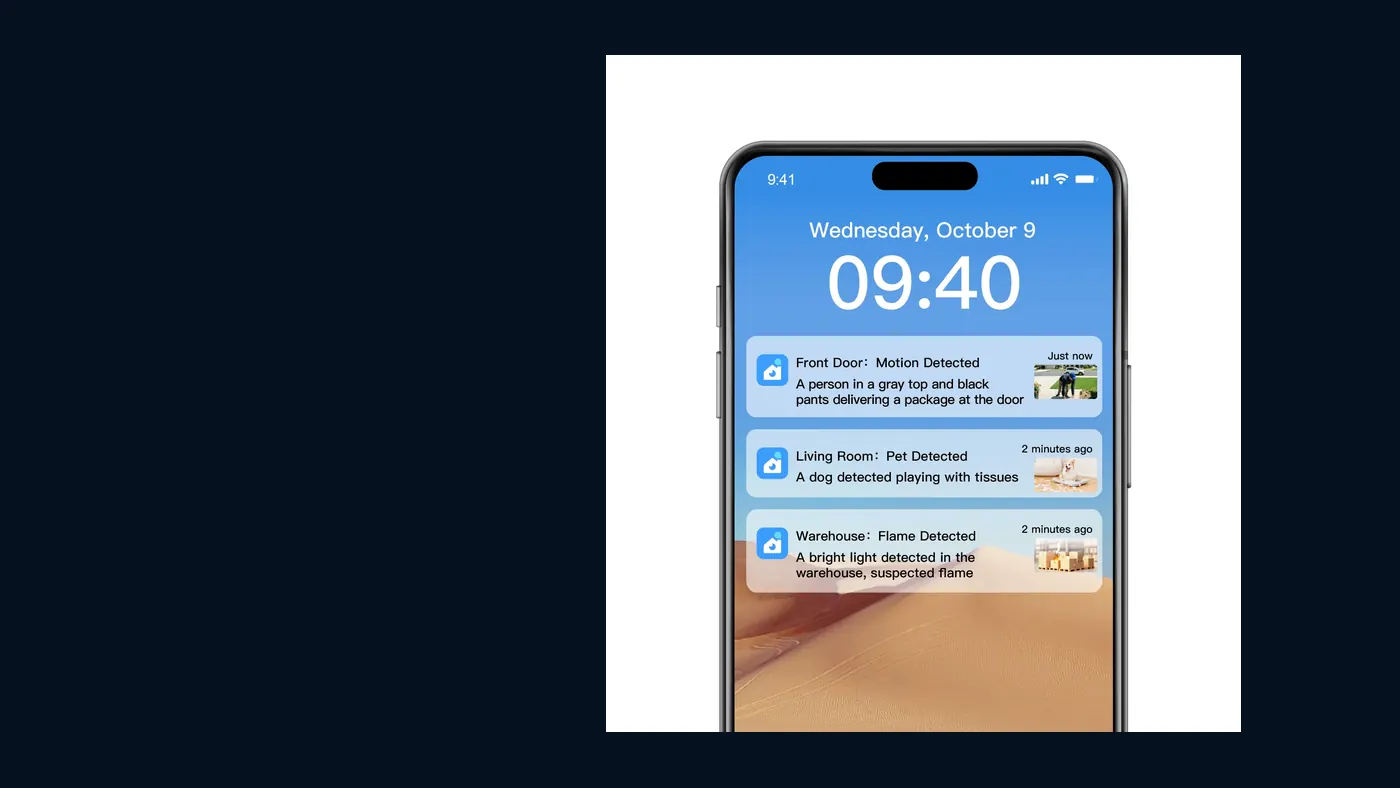
A motion detection cctv camera works best when you tune four things in this order: the camera angle, the detection zone, the sensitivity level and, if your model has it, human-shape filtering. Fix the angle first so trees, roads and lights are out of the picture; draw the zone around the places people actually walk; then lower sensitivity one step at a time until swaying leaves stop triggering but a person at the door still does. Change one setting per test, and test in daylight and after dark.
This article is about what triggers detection and how to make it trigger on the right things. If the camera detects correctly but your phone never shows an alert, that is a delivery problem covered in why app notifications stop arriving.
How home camera motion detection actually decides
Most home and surveillance cameras use one of two methods, and knowing which one yours uses explains most of its odd behaviour.
Pixel-change detection. Many mains-powered Wi-Fi cameras compare one frame of video with the next. If enough of the image changes, that counts as motion. The camera does not know what changed — a person, a shadow, a moth on the lens or headlights sweeping a wall all look like "the picture changed". Sensitivity controls how much change is needed.
Heat-based (PIR) detection. Many battery and solar cameras use a passive infrared sensor that reacts to warm bodies moving across its view, then wake the camera to record. PIR ignores most shadows and light changes, but it reacts to pets, warm car engines and sometimes hot air from a vent, and it is weaker at detecting someone walking straight towards it than someone crossing the frame. Battery cameras also take a moment to wake, which is why their clips can start late — and detection settings affect battery life too, as solar camera battery life explains.
Human-shape filtering, offered on some models and app versions under names like human detection or person detection, adds a second check: after motion is seen, the camera tries to decide whether the moving shape looks like a person. It cuts out a lot of noise, but it is a filter on top of motion detection, not a replacement for it. If motion is never triggered, the person filter never gets a chance to run.
Check your model's manual or product listing to see which method your camera uses and whether person detection is offered. Menu names may differ slightly by app version.
Step 1: Fix the camera angle before touching any setting
No sensitivity slider can rescue a camera pointed at a busy road. Before opening the settings, look at the live view and ask what in the frame moves when nobody is there.
The usual offenders:
- Trees, hedges and hanging plants. Wind makes them move all day, and their shadows move across the ground in sunlight.
- Roads and pavements beyond your property. Every passing car, cyclist and pedestrian is motion.
- Headlights and street lights. At night, a car turning into a nearby road throws a moving patch of light across walls and the ground. Pixel-based detection sees that as motion.
- Flags, washing lines and curtains near an open window.
- Water — pools, fountains, puddles reflecting light.
- Insects and spider webs near the lens. At night the infrared lights attract insects, and anything a few centimetres from the lens looks enormous.
Tilt the camera down slightly so the horizon and the road drop out of the top of the frame. Turn it so trees sit at the edge or out of view. If a security light or porch light sits right beside the camera, move one of them. Repositioning often solves false alerts that no setting can fix. If you are still choosing positions, where to place security cameras around a house covers the entry-point approach, and how high to mount an outdoor camera covers the height and downward angle.
If moving the camera means working on a ladder or near a wired power point, switch off the power first, have someone hold the ladder, and use a qualified electrician for any change to mains wiring.
Step 2: Draw the detection zone around paths, not the whole picture
Most models let you choose which part of the image is watched, usually in the camera's settings under something like Alarm Settings, Motion Detection or Detection Area. Depending on the model and app version, you either tick a grid of boxes or drag a rectangle over the live picture.
How to draw a useful zone:
- Start from the places a person must cross — the path to the door, the gate, the strip in front of a window, the drive.
- Leave out the top of the frame if it contains sky, trees or the street.
- Leave out anything that moves on its own — the hedge, the neighbour's driveway, a reflective window.
- Do not make the zone too small. A zone drawn tightly around the door handle can miss someone until they are already at the door, so the clip starts too late. Include the last part of the approach.
- Save, then check it in the live view with someone walking the route.
A common mistake is drawing the zone once and forgetting it. After you move the camera even slightly, the zone no longer lines up with the ground, so redraw it after any repositioning.
Step 3: Set sensitivity one step at a time
Sensitivity is usually a slider or a set of levels such as low, medium and high. There is no correct universal value — it depends on distance, lighting and what is in the frame.
A practical method:
- Start in the middle.
- Walk the path yourself at a normal pace, at the far edge of the zone, where a person appears smallest.
- If you were not detected, raise sensitivity one step and walk again.
- If you were detected, leave it for a day and look at the event list in the app.
- If the list is full of events with nobody in them, lower one step and look again the next day.
Two things to keep in mind. First, distance matters: a person far away changes only a small part of the image, so a low setting may never notice them. That is a reason to aim the camera at nearer paths rather than turning sensitivity up. Second, night behaves differently. In infrared mode the image is noisier and insects are brighter, so a level that is perfect by day can be noisy at night. Some cameras let you set a schedule for detection; if yours does, you can test whether night alerts need a lower level. If the night picture itself is poor, start with why cameras look blurry at night.
Step 4: Turn on human detection if your model has it
If the settings include human detection, person detection or a similar option, turning it on is often the single most effective way to stop alerts from cars, shadows and leaves.
Know the trade-offs:
- Pets and animals are usually filtered out, which is what most people want — but a large dog may still be counted on some models.
- People partly hidden behind a gate, wearing a large coat, carrying a box or crouching may be missed. If you rely on the filter for an important door, test it with the kind of clothing and movement you expect.
- Very small figures at a distance may not be recognised as people. Again, aim closer.
- At night, recognition depends on how well the infrared lights the person.
If you turn on the person filter and alerts drop to nothing, check whether ordinary motion detection is still switched on underneath it. On many models both need to be enabled.
Step 5: Make sure the clip starts early enough
A very common complaint is "the camera detected them, but the clip starts after they walked past". This is a timing problem, not a sensitivity problem.
Check these in order:
- Pre-recording. Some cameras keep a short buffer and add the seconds before the trigger to the clip. If the option exists in your recording settings, turn it on.
- Battery wake-up delay. Battery cameras need a moment to wake after the PIR sensor fires. Move the zone outward so the person is detected earlier on their approach, rather than right at the door.
- Recording mode. If event-only recording keeps missing the start, continuous recording to a memory card is the most reliable way to keep the moment before motion, as long as the card is healthy and recording is actually running. Card capacity and loop recording then decide how far back you can go — see why a camera is not recording to the SD card.
- Clip length. If clips end while the person is still in view, look for a recording duration or alarm duration option and increase it.
To find and review those clips, how to watch playback recordings walks through the timeline.
Step 6: Use schedules for the hours you care about
An arming schedule tells the camera when to detect. It is useful, but it is also the most forgotten setting: people set alerts for night only, then wonder why nothing is detected in the afternoon.
Sensible uses:
- Indoor cameras detecting only while the house is empty or at night.
- Shop cameras detecting after closing time, so staff and customers do not flood the event list.
- Outdoor cameras on a busy frontage detecting at night, with daytime handled by continuous recording.
Write down what you set. If you share the camera with family, anyone with permission to change settings can alter the schedule too, so agree who manages it — sharing a camera with family explains the access levels.
Reading the symptoms
Use the event list in the app to diagnose. Each pattern points to a different fix.
| Symptom | What it usually means | What to try |
|---|---|---|
| Events every few minutes with nobody in them, daytime | Trees, shadows or a road in the zone | Re-aim, shrink the zone, lower sensitivity |
| Bursts of events only at night | Insects, headlights or infrared reflection | Move nearby lights, clean webs, lower night sensitivity |
| Events only on windy days | Vegetation in the zone | Trim plants or remove that area from the zone |
| People walking past are not detected | Sensitivity too low, zone too small, or person too far | Raise one step, widen zone, aim closer |
| Detected, but clip starts late | No pre-record, or battery wake-up delay | Enable pre-record, detect earlier on the path |
| Nothing at all for hours | Detection off, schedule excludes those hours, or camera offline | Check the switch, the schedule and the camera status |
| Events listed but no alert on the phone | Phone permissions or battery saving | See the notifications article linked above |
When to get help
Contact the seller or the place you bought the camera if:
- The event list stays empty after you have turned detection on, checked the schedule and confirmed the camera is online.
- Detection triggers constantly even with the zone reduced to a small area and sensitivity at the lowest level — this can point to a faulty sensor or lens issue.
- The infrared lights or the night picture fail completely.
- The settings you need, such as the zone or person filter, do not appear and you want to know whether your model supports them or needs a firmware update.
Before you call, note the model from the label on the camera, the app version, and a few example events with their times. That turns a vague "it does not work" into something the seller can check.
Frequently asked questions
Why does my camera detect motion when nothing is there?
Something in the frame changed that you did not notice. Play a few of the empty clips frame by frame and note the time of day: midday clips with no one in them usually point to moving shade, night clips to insects or headlights. Fix that one cause rather than lowering sensitivity across the board.
Can motion detection tell the difference between a person and a cat?
Plain pixel-change detection cannot, and a heat sensor reacts to a warm cat much as it does to a person. Only a person detection filter tries to tell them apart, and it is not perfect with large dogs. If your model's settings do not show such an option, a firmware update may or may not add it, so ask the seller before relying on it.
Does rain set off motion detection?
It can, especially at night when infrared light reflects off raindrops close to the lens, and when water runs over the lens itself. A small roof or hood above the camera helps, as does lowering sensitivity during bad weather. Heat-based sensors react less to rain than pixel-change detection does.
Does motion detection work through a window?
Usually not well. Heat-based sensors cannot sense warmth through glass, and at night the infrared lights reflect off the window and blind the camera. For outdoor coverage, mount the camera outside or use an outdoor-rated model.
Should I use motion recording or continuous recording?
Motion recording saves space and makes finding events quicker, but clips may start after the movement began. Continuous recording captures everything, at the cost of filling the memory card faster and relying on loop recording. Many people use continuous recording for the most important door and motion recording elsewhere.