
Watching Yoosee Cameras on a Computer: Windows and Mac
Yoosee was built as a phone app, so there is no single "desktop version" that mirrors everything you see on your handset. In practice you have two routes: a desktop client installed on Windows, or the phone app running inside an Android emulator on either Windows or a Mac. Both give you live video on a big screen. Where they differ is in the extras — playback, two-way audio and pop-up alerts behave differently on a computer than they do on a phone, and some of it depends on which camera you own.
This article covers the desktop side only. Phone-side tasks — pairing a camera, changing its settings — are covered in the linked articles.
First: check what your model and your account support
Before you download anything, it is worth knowing that camera features are not uniform across the range. Different models ship with different hardware and different firmware, so "does this work on a PC" has no single answer that covers every camera sold under the brand.
Three places give you a reliable answer for the camera in your hands:
- The manual in the box. It lists what that specific model supports, including whether it exposes any standard protocol a third-party viewer could use.
- The product listing for your exact model, not a generic page for the brand. If you are not sure what you bought, start with a quick overview of what a Yoosee camera is and match the label on the camera body to the listing.
- Whoever sold it to you. For anything about compatibility with desktop software or with a video management system, the seller can answer for the batch you received.
If you plan to feed the camera into third-party recording software, ask the seller whether your model opens a standard streaming protocol. This varies by model, so confirm it before you buy rather than after.
Route 1 — The desktop client on Windows
If a desktop client exists for your camera, this is the cleanest route: install it, sign in with the same account you use on your phone, and your camera list appears.
Downloading it without picking up malware
Camera software is a favourite disguise for malware, because people search the software name, click the first result, and run whatever downloads. A few rules that cost nothing to follow:
- Only download from the official product site or the seller you bought from. Avoid software-aggregator sites, shortened links, and installers forwarded to you in a chat message.
- Be suspicious of password-protected archives. That trick exists to stop antivirus software scanning what is inside. A normal installer does not need a password to unzip.
- Check the file extension. On Windows an installer is
.exeor.msi. If what lands in your Downloads folder is.scr,.bat,.js, or an.exethat is implausibly small, delete it. - Scan before you open it, and read every installer screen. Bundled extras hide behind pre-ticked boxes.
Signing in the first time
Use the same login as on the phone — the same phone number or email address, whichever you registered with. Many "the client shows no cameras" reports are simply someone signing in to a second account created by accident.
When Windows asks whether to allow the program through the firewall, allow it on private networks. Blocking at that prompt is one of the most common reasons a client installs fine but never connects to anything.
If you are installing on a computer other people use — the back office of a shop, a shared family desktop — do not sign in with the owner account. Share the camera to a second account instead, and sign in with that one. You can withdraw access later without changing the main password, and nobody sitting at that desk can delete a camera from the account.
Route 2 — The phone app in an Android emulator
An Android emulator is a program that runs Android inside a window on your computer. You install it, then install the phone app inside it, and you get the phone interface on a big screen.
This route matters because the emulator runs the same app your phone runs, so a feature that exists on mobile usually exists here too. A desktop client is separate software with its own, often shorter, feature list.
When the emulator is the better choice
- Your model has no desktop client at all.
- You want the interface you already know, rather than learning a second layout.
- You need a feature that the desktop client does not offer.
What to watch out for
- Only install the emulator from its own official site. Repackaged builds circulating on download portals are a known malware vector.
- Expect it to be heavy. An emulator runs a whole second operating system; on an older laptop the fan will tell you about it.
- Microphone and speaker permissions are separate. The emulator has to be allowed to use your computer's microphone, and then the app inside it has to be granted the microphone permission as well. Miss either one and talkback stays silent.
Mac and macOS: the realistic options
Camera software tends to be written for Windows first, so on a Mac you are usually choosing between three approaches.
An Android emulator on macOS. Same idea as above, and generally the most practical route. Check that the emulator you pick has a build for your Mac's processor type before you download it.
Windows in a virtual machine. Run Windows inside macOS and install the Windows client there. You get the real client, at the cost of disk space, memory and a longer setup — reasonable if you already run a virtual machine, heavy-handed if this is the only reason.
Mirror your phone screen to the Mac. No installation at all: you cast the phone display and watch it on the larger screen. It is the fastest option for a quick look, but the phone has to stay awake and every tap still happens on the phone.
A simple rule: mirroring for a glance, an emulator or virtual machine if you plan to sit and monitor for hours.
What desktop viewing supports — and what it does not
As a general principle, desktop versions of camera software arrive later and carry fewer features than the mobile app. Rather than promise what your model does, here is what to check once you are set up.
Live view and multi-camera grids
This is the reason most people want a computer in the first place, and it is the part that works best. A large monitor splits into several panes, so a shop owner can watch the entrance, the till and the stockroom at once.
The limit is bandwidth and processing power, not screen space. Every pane is a separate video stream. If the picture stutters as you add cameras, switch the grid to the lower-quality stream and keep the high-definition one for the camera you are actually studying.
Playback of recorded footage
Playback on a computer reads the same source the phone reads: the memory card inside the camera. If the desktop client offers a playback tab, the timeline behaves the same way, and a big screen makes scrubbing through a long day considerably easier. If you are not sure how the timeline is put together, the playback timeline is explained here.
Exporting a clip is where desktop and mobile diverge most. Some clients save to a folder on your hard drive, some do not offer export at all. Test it once on a clip you do not care about, so you are not learning the interface on the day you actually need footage.
Two-way audio
Talkback on a computer depends on three things lining up: your model has a speaker and microphone, the software you are using implements the feature, and your computer's own audio devices are selected correctly. On a desktop the third one causes most failures — a headset that is plugged in but not chosen as the input device produces exactly the same symptom as a broken camera. If the button is there but nobody hears you, the two-way audio checklist applies to computers as much as phones.
Motion notifications
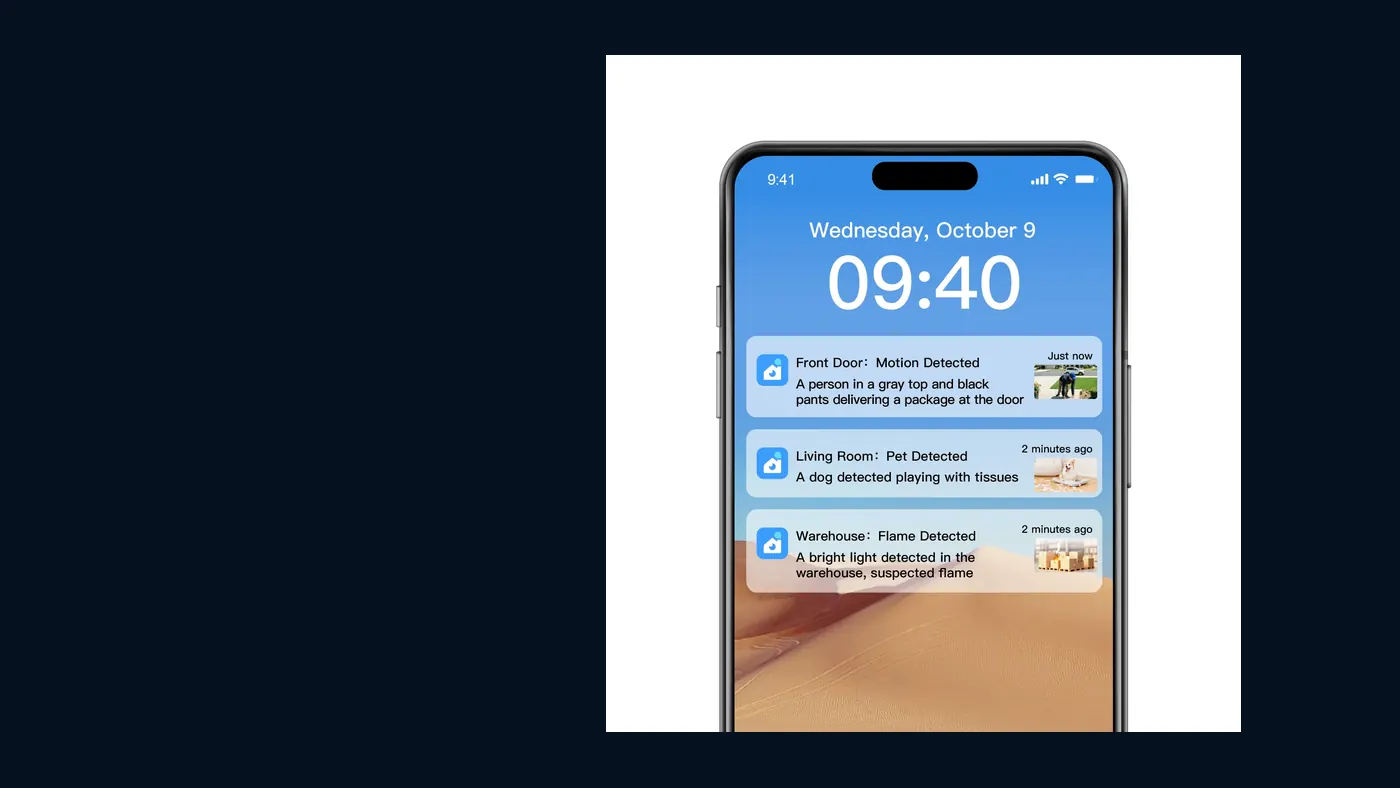
This is the biggest real gap. A phone receives push notifications through the operating system even when the app is closed. A computer generally does not: alerts show up while the software is open and running, and stop mattering the moment you close the window or the machine sleeps.
If alerts are the point, keep the phone as your alert device and use the computer for watching. If notifications are not arriving on the phone either, that is a separate problem with its own notification troubleshooting steps.
Desktop-only problems and what they usually mean
- Signs in, but the camera list is empty. Almost always the wrong account, or a camera that was shared to you rather than registered to you. Compare against the list on the phone.
- Nothing connects, no error explains why. Check the firewall prompt you may have dismissed, then allow the program on private networks in your firewall settings.
- Works at home, fails at the office. Many corporate and school networks block the ports camera software uses. Test on a phone hotspot: if it connects there, only the network administrator can fix it.
- Video stutters or freezes with several cameras open. Reduce the number of panes, switch to the lower-quality stream, and prefer a wired connection over Wi-Fi for the computer itself.
- No sound. Check the system volume, check which output device is selected, and check that the speaker icon is enabled inside the software. Not every camera has a microphone.
- The client will not launch. Run it as administrator, update it, and reinstall from the official source if it still fails.
Frequently asked questions
Can I watch a Yoosee camera on my computer?
Yes, by one of two routes: a desktop client on Windows if one exists for your model, or the phone app running inside an Android emulator on Windows or macOS. Live viewing works on both. Check your manual or ask your seller which route applies to your camera.
Where is it safe to download the PC client?
Only from the official product site or from the seller you bought the camera from. Software-aggregator sites and installers sent through chat apps are the two most common sources of tampered files. The clearest warning signs are a password-protected archive and an unexpected file extension — delete both rather than opening them.
Does Yoosee work on a Mac?
There is usually no dedicated Mac application, so people run an Android emulator on macOS, run Windows in a virtual machine, or mirror the phone screen to the Mac. The emulator route is the most practical for regular use; mirroring is fine for an occasional look.
Will signing in on a computer log me out on my phone?
Normally you can use both at once. If the computer is shared, the safer arrangement is a second account with viewing rights shared to it, so you can withdraw access without changing your main password.
Can I record to my computer's hard drive instead of the camera's card?
That depends on the software and the model, so treat it as something to verify rather than assume. Test the export or local-recording function once, on footage you do not need, before you rely on it.
Installing cameras for customers, or buying in volume?
Installers and shops usually need several sites on one screen, and want to know what is supported before committing to a batch. If you sell, install or distribute cameras, partner information is on the Yoosee business page.