
How to Zoom a Security Camera View, and Why Faces Still Look Soft
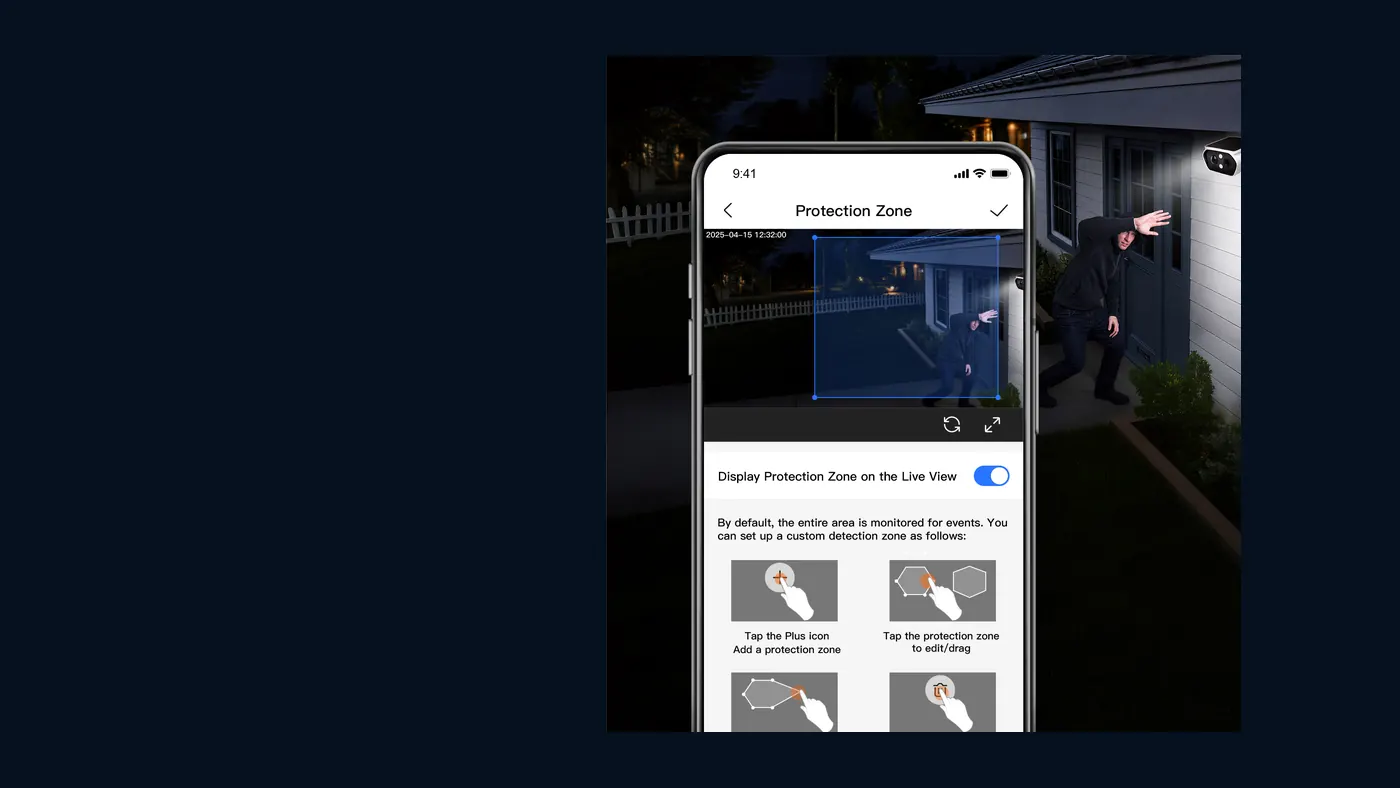
To zoom security camera footage in the Yoosee app, spread two fingers on the video, either in live view or on a paused playback frame, and drag to move around the enlarged picture. On most home cameras this is digital zoom: the app enlarges pixels the camera has already captured, so it makes small things bigger but cannot add detail that was never recorded. Only a camera with a motorised zoom lens, known as optical zoom, can bring a distant face closer before the picture is taken. If a zoomed face looks soft, the fix is usually the stream quality, the recording quality or the camera position, not more zoom.
The steps below cover live view first, then playback, then what each type of zoom can and cannot do, and finally the checks that make a zoomed image as sharp as your camera allows. Menu names can differ slightly between app versions and camera models, so treat the labels here as a guide rather than exact wording.
Zooming in on live view
Live view is where most people first try to zoom, usually because something caught their eye at the edge of the frame.
- Open the camera from the device list and wait until the picture is moving smoothly. Zooming while the stream is still loading often gives a blocky, frozen image.
- Switch to the higher-quality stream. Most models offer two streams, shown as something like SD and HD, or standard and high definition, near the bottom of the player. The lower stream exists to save data on weak connections; it sends far fewer pixels, so zooming into it falls apart almost immediately. Pick the higher one before you zoom.
- Turn the phone sideways for full-screen view. You get more screen pixels to display the enlarged area, which makes a real difference on a phone.
- Pinch outwards on the area you want to see. Spread your fingers apart to enlarge, pinch them together to zoom back out. On some app versions a double tap also resets the view; if it does not, simply pinch back in.
- Drag with one finger to move around the enlarged picture without losing the zoom level.
If pinching does nothing at all, check whether you are touching the video area itself rather than the control bar. On some layouts the control buttons sit over the bottom of the picture and intercept the gesture. Updating the app also helps, because the player has changed over versions.
Pinch zoom versus moving the camera
If your camera can pan and tilt, there are arrow controls or a direction pad in live view, and on many models you can also swipe across the picture to turn the camera. That is different from zooming. Turning the camera points the lens somewhere else; pinching enlarges part of what the lens already sees. A useful habit is to turn the camera first so the subject sits near the centre, then pinch in, because the centre of the frame is usually the sharpest part of the lens.
Zooming in on playback recordings
Zooming on a recording works the same way, with one difference that matters: you are enlarging what was saved, and what was saved is fixed. If you are new to finding footage on the timeline, the basics are covered in how to watch Yoosee playback and save a clip.
- Open playback and find the moment on the timeline.
- Pause on the clearest frame. Moving footage is a stream of compressed frames, and the frames just after a quick movement are often the blurriest. Step back and forth until you find one where the person is still, or at least facing the camera.
- Pinch to zoom on the paused frame and drag to the face, number plate or object.
- Take a snapshot if you want to keep the zoomed moment. Many app versions show a snapshot or camera icon in the player; where the image is saved (the app's own album or your phone's gallery) varies by version, so check both.
Be aware that a snapshot may save the full frame rather than only the enlarged part you were looking at, depending on the app version. If it does, open the image in your phone's photo editor and crop it there; the result is the same pixels either way.
Why playback zooms worse than live view
People often notice that live view looked sharper than the recording of the same moment. Two common reasons:
- The recording was saved at a lower quality. Many cameras let you choose a recording or video quality in the settings. A lower setting fits more days on the memory card but stores fewer details. The setting is usually under the camera's settings page, in a section about recording or video, and the exact name varies by model.
- Playback was streamed in the lower quality. When your connection is slow, playback may be sent at a reduced quality to keep it moving. Switch the playback stream to the higher option if your model offers one, and try again on a better connection.
If the footage that matters most is at night and looks foggy or washed out even before you zoom, zoom is not the problem. Read why a camera looks blurry at night first, because infrared glare and a dirty lens ruin detail that no amount of enlarging can recover.
Digital zoom and optical zoom: the real difference
This is the part most product listings gloss over, and it explains almost every disappointed "I zoomed in and still could not see the face" moment.
Digital zoom
Every camera sensor captures a fixed grid of pixels. Digital zoom takes a small piece of that grid and stretches it to fill your screen. Nothing new is captured; each original pixel is simply shown larger, and the phone smooths the edges so it looks less blocky. This is what pinch zoom in the app does, and it is what most home cameras mean when a listing mentions zoom.
Digital zoom is genuinely useful for one thing: making small details easier for your eyes to read when the detail is already there. If a person's face covers a decent patch of the frame, enlarging it helps you recognise them. If their face covers only a handful of pixels, enlarging it gives you a bigger, smoother smudge.
Optical zoom
Optical zoom changes the lens itself. Glass elements move inside the camera to narrow the field of view, so the distant scene is spread across the whole sensor before the picture is taken. The result is genuinely more detail on the faraway subject, at the cost of seeing a smaller area.
Some cameras have a motorised zoom lens; most compact home cameras do not. If yours does, the live view usually shows separate zoom-in and zoom-out buttons, often marked with a plus and minus or a magnifier, in addition to pinch zoom. Check the manual or the label for your model rather than assuming. Two things to know if you have one:
- Optical zoom only helps the live picture and what is recorded from then on. It cannot sharpen footage already saved.
- A zoomed-in camera watches a smaller area. If you leave it zoomed on the gate, it may not see someone walking along the side of the house. Many people zoom optically to check something, then return to the wide view.
Why a zoomed-in face still looks soft
A soft face after zooming almost always comes down to one of five things. Work through them in this order, because the first ones cost nothing to fix.
- Too few pixels on the face. This is the big one. The further a person is from the camera, the fewer pixels their face covers. As a worked example of the geometry: if someone walks to half the distance from the camera, their face covers roughly twice as many pixels across and four times as many in total. That is why moving the camera closer to where faces appear beats any zoom setting.
- The low-quality stream. Zooming into the SD stream is the most common avoidable cause. Switch to HD before judging the camera.
- Compression and movement. Video is compressed to save space and bandwidth, and fast movement is where compression throws away the most detail. A person walking briskly is softer than the same person standing still. Pause on a still moment.
- Low light. In dim light the camera has to boost its signal and lengthen exposure, which adds grain and smear. At night, infrared footage is black and white and less detailed than daylight video on most cameras.
- A dirty lens or the wrong focus. Dust, fingerprints and spider webs make the whole image hazy, and zooming exaggerates the haze. Wipe the lens with a soft, dry microfibre cloth. Many compact cameras have fixed focus, so if the image is soft everywhere after cleaning, contact the seller rather than trying to adjust it yourself.
How far can a security camera see?
This is the question behind most zoom searches, and there is no single honest figure. A camera can "see" a car at a long distance in the sense that something is visible, but recognising a face or reading a number plate needs far more pixels on the subject. The useful distance depends on the sensor resolution, the lens width, the light and the stream quality, and all of those vary by model.
A practical test answers it for your own camera. Ask someone to stand at the spot you care about, such as the gate, and walk slowly towards the camera while you watch live view on the HD stream. Note the point where you can confidently recognise their face, then the point where you could read a number plate held at chest height. Repeat after dark. Those two spots are your real working range, and they are often closer than people expect.
Getting better detail without more zoom
Once you know zoom cannot create detail, the improvements all come from capturing more of it in the first place.
- Move the camera closer to the place faces appear. A camera aimed at the front door from beside the door gives clearer faces than one at the far corner of the garden. Placement ideas for a typical home are in where to place security cameras around your house.
- Fix the mounting height and tilt. A camera mounted very high records the tops of heads, and zooming into a hat does not help. The trade-offs are explained in how high to mount an outdoor camera.
- Aim along the path, not across it. Someone walking towards the camera stays in a similar part of the frame for longer, giving you more clear frames to pause on. Someone crossing the frame sideways is a blur.
- Raise the recording quality if your card allows. A higher setting uses more storage, so check how many days of history you still keep afterwards.
- Add light where faces appear. A porch light or motion-activated light by the door often improves night detail more than anything else, as long as it does not shine straight into the lens.
If you have to move a camera that is wired into mains power or mounted high on a wall, switch off the power first and use a stable ladder with someone holding it. For anything involving mains wiring, use a qualified electrician.
When to get help
Most zoom complaints are solved by the checks above. Contact the seller or the support channel listed for your model if:
- The image is soft everywhere, including close to the camera, after cleaning the lens and switching to the HD stream.
- Zoom buttons appear in live view but the lens never changes, or it makes grinding sounds.
- The picture is noticeably sharper on one side of the frame than the other, which can point to a lens or focus fault.
- The higher-quality stream option is missing when the manual for your model says it should be there.
When you get in touch, include the camera model from the label, the app version, and two snapshots taken on the HD stream, one in daylight and one at night. That saves a round of questions.
Frequently asked questions
Can I zoom in on a recording after it has been saved?
Yes, but only within what was saved. Pause on a still frame, pinch in, and keep a snapshot if you need it. If the recording quality setting was low, raise it now so future footage holds more detail; nothing can restore detail that was never stored.
Does zooming in live view change what the camera records?
Pinch zoom does not; it only changes what your phone displays, and the recording keeps the full frame. Optical zoom, on models that have it, does change what is recorded, because it narrows what the lens sees. Remember to return an optical zoom camera to the wide view if you need full coverage.
Why can I read a number plate in daylight but not at night?
At night most cameras switch to infrared, which gives a grainier black and white image, and number plates are reflective, so infrared light can bounce off them and wash out the characters. Moving traffic adds motion blur on top. A closer camera position and a steady light source near the parking spot usually help more than zooming.
Is a higher resolution camera always better for zooming?
More pixels give digital zoom more to work with, so a higher resolution usually helps, but only when the recording quality, light and connection let those pixels reach your screen. A high resolution camera viewed on the low stream, or recording at a low quality setting, can look no better than a cheaper one. Lens quality and placement matter as much as the resolution figure.